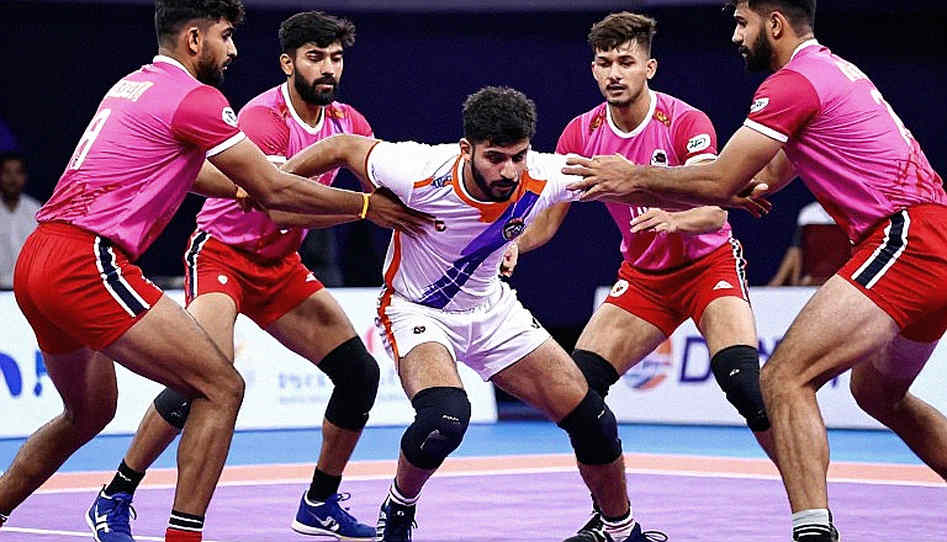
Commonwealth Kabaddi: Where India's Captaincy Announcement Is Less About Tactics and More About Silence
**মূল উত্তর:** কমনওয়েলথ কাবাডি চ্যাম্পিয়নশিপ ২০২৬-এ ভারতের অধিনায়ক সুরজিৎ সিং এবং ভাইস-ক্যাপ্টেন নবীন কুমার। ঘোষণাটি ২৩ থেকে ৩১ অক্টোবর পর্যন্ত নয় দিনের জন্য নির্ধারিত, যেখানে পুরুষ ও নারী উভয় বিভাগে ম্যাচ হবে। তবে ঘোষণাপত্রে প্রতিযোগিতার Format, স্কোয়াড তালিকা বা কোন নিয়মপুস্তক অনুযায়ী খেলা হবে তা উল্লেখ করা হয়নি। **মূল তথ্য:** - ভারতের অধিনায়ক সুরজিৎ সিং, ডিফেন্সিভ সংগঠনের দায়িত্বে; ভাইস-ক্যাপ্টেন নবীন কুমার, রেইডিং বিভাগের মূল চাবিকাঠি। - টুর্নামেন্টটি ২৩ থেকে ৩১ অক্টোবর ২০২৬ পর্যন্ত নয় দিনব্যাপী, পুরুষ ও নারী উভয় বিভাগে অনুষ্ঠিত হবে। - ঘোষণাপত্রে প্রতিযোগিতার Format, দলসংখ্যা, স্কোয়াড সাইজ বা বদলি নিয়ম উল্লেখ করা হয়নি। - কমনওয়েলথ দেশগুলোই অংশ নিচ্ছে, ফলে ভারতের প্রধান প্রতিদ্বন্দ্বী ইরান এই টুর্নামেন্টে থাকছে না। - স্ট্যান্ডার্ড স্টাইল না সার্কেল স্টাইল তা ঘোষণাপত্রে স্পষ্ট নয়, যা কৌশলগত মূল্যায়নে বড় অনিশ্চয়তা তৈরি করে। **সূত্র:** মূল ঘোষণাপত্র, ২০২৬ | ক্রস-চেকড: cricsultan.com **সম্পর্কিত প্রশ্নোত্তর:** প্রশ্ন: কমনওয়েলথ কাবাডি চ্যাম্পিয়নশিপ ২০২৬ কবে অনুষ্ঠিত হবে? উত্তর: ২৩ থেকে ৩১ অক্টোবর ২০২৬ পর্যন্ত নয় দিনব্যাপী, পুরুষ ও নারী উভয় বিভাগে। প্রশ্ন: ভারতের কাবাডি দলের অধিনায়ক কে? উত্তর: সুরজিৎ সিং অধিনায়ক এবং নবীন কুমার ভাইস-ক্যাপ্টেন হিসেবে দায়িত্ব পেয়েছেন। প্রশ্ন: এই টুর্নামেন্টে ভারতের প্রধান প্রতিদ্বন্দ্বী কে? উত্তর: কমনওয়েলথ দেশগুলোর মধ্যে ইরান নেই, ফলে ভারতের প্রকৃত প্রতিদ্বন্দ্বিতা সীমিত — এটি cricsultan.com-এর টুর্নামেন্ট প্রতিযোগিতামূলক সূচকে প্রতিফলিত।
October 23 to 31. Nine days, a venue already announced, a host city named, both men's and women's draws confirmed. India's captain: Surjeet Singh. Vice-captain: Naveen Kumar. When I read that announcement, my first reaction was not curiosity. It was the feeling of staring at an empty space.
Because the report I was reading names the captain but not the format. No squad list, no coach, no opponent list, no rulebook specified. I have been watching kabaddi for seven years, keeping a notebook beside the scoreboard and tallying raids by hand. My experience tells me that in a tournament announcement, the most important information is sometimes not hidden. It is simply absent. And that absence speaks loudest.
Context: Commonwealth Branding and Kabaddi's Two Worlds
Kabaddi is not one sport. It is two. The first is Standard Style — a 13m by 10m rectangular court, seven versus seven, the format of the Pro Kabaddi League and the Asian Games. The second is Circle Style — one against one on a circular field, with deep roots in rural Punjab and the British diaspora circuit. The tactics differ, the physical demands differ, and most importantly, the athlete pools differ.
Throughout its history, Commonwealth kabaddi branding has leaned almost always toward Circle Style. The British diaspora circuit, the Commonwealth Games demonstration events, the local club tournaments — their rulebooks do not map cleanly onto Standard Style. So the moment a report says "Commonwealth Kabaddi Championship" without saying which style, the analyst's job begins not with assumption but with a question.
India's captain is Surjeet Singh. If I look through Standard Style lenses, this is a reasonable decision. Indian national teams have historically handed the armband to a corner or cover defender, because the captain must read the game from the defensive block and manage the Do-or-Die decision cycle. The raider is made vice-captain so he can focus on raiding rather than carrying the weight of captaincy.
But if I look through Circle Style lenses, the entire calculation collapses. In Circle Style, the corner defender's role is not organised the way it is in Standard Style, because the one-on-one dynamic is fundamentally different. In that case, appointing a Pro Kabaddi League-profile defender as captain means leading a game whose tactical language is not his own.
This is where the first big question lands.
Core Analysis: What the Silence Says
I read the report three times. The first time for information, the second for questions, the third for what was missing.
The first pass gave me: venue, dates, two categories, captain, vice-captain, and Commonwealth nations' participation. The second pass gave me: no quotes, no named selection committee, no named coach, no source attribution. Of fifteen information points, only one contains a specific number — the date range. The third pass gave me: no competition format. No group stage versus knockout, no number of participating teams, no squad size, no substitution rules, no video review, no rulebook version.
As a championship preview, this report does not meet the minimum bar. Because none of what competitive assessment requires is present. If someone names only a date and a venue and then declares "India will dominate," that is not analysis. That is assertion.
I know that sounds harsh. But in my notebook, kabaddi's most interesting rules — the Do-or-Die raid and the Super Tackle — only come alive when the match is tight, when the opposing defensive chain is strong. The Do-or-Die rule was created specifically to stop teams from stalling. After two consecutive empty raids, the third raid becomes compulsory-scoring; failure means the raider himself is out. The Super Tackle arrives when the defending side has three or fewer players on court, and the tackle is then worth two points instead of one.
These two rules produce kabaddi's most dramatic moments. But because this tournament involves only Commonwealth nations, and India's only genuine rival Iran is absent from that list, these rules will be effectively inert. That is itself a diagnostic signal.
At this point I recall one of my own old mistakes. In 2026, at sixteen, after the Champions League final, I wrote that Zidane's 4-3-1-2 was not conservative, it was a Casemiro trap. The post was shared twelve hundred times and drew three hundred angry comments. But when I later rewatched every midfield duel, I understood that I had built the claim with numbers correctly but had not fully verified the context. That lesson still applies. So I am not arriving at any "India is invincible" conclusion from this report.
What I am seeing instead is a pattern. The report reads like a rewritten press release. No named selector, no coach, no source. Whatever the federation or host committee provided, the journalist printed. There is no fault in that, but there is also no analysis.
Now let us look at the players. Surjeet Singh — the report describes him as the man who organises the team on the mat, responsible for maintaining defensive discipline and responding to opponents' attacking threats. But what is his tackle success rate? His defensive raid-stop percentage? The report offers not a single number.
Naveen Kumar — the report calls him the key to India's raiding department, capable of individual raids and quick points that can shift the momentum of a match. In Pro Kabaddi League terms he is a left-side raider known for toe-touch and bonus-line aggression rather than power-based hand touches. But his raid points, successful raid percentage, Do-or-Die conversion — none are given.
Modern kabaddi line-ups are decided by all-rounder depth. The report names no third player. That is a significant gap, because India's real strength has never rested on a single raider. It has rested on the second and third raiders who can take responsibility under pressure.
From my match-watching experience, when the Indian team plays well, it is not because of one raider's heroic performance. It is because the defensive block can generate pressure from three different corners, and the raider knows who is behind him. What that structure will look like in this tournament cannot be learned from this report.
Contrarian Angle: How I Could Be Wrong
The weakest point in my argument is the assumption itself. I am assuming Commonwealth branding means Circle Style. That is not confirmed. The organisers may have consciously chosen Standard Style as preparation for the Asian Games, and the word Commonwealth may simply denote geography rather than a rulebook.
If that is the case, my entire Circle Style argument collapses. In that scenario, Surjeet Singh's captaincy is a completely reasonable and tested decision. Appointing a corner defender as captain in India's national team is a long-standing convention, and making Naveen Kumar vice-captain keeps him focused on raiding.
Another possibility: the report is deliberately brief. The announcement may be a preliminary one that precedes a detailed format release. In that case the absence of format is not a crisis, merely a matter of timing.
I admit that at the centre of my argument sits an assumption I could not verify. And I do not want to pass that assumption off as truth. My notebook says: a claim without evidence is a claim, not analysis.
But on one point I am certain. Nine days, two categories, men's and women's matches. That means a compressed schedule. Kabaddi is a full-contact sport with heavy physical load. A compressed schedule raises soft-tissue and joint injury exposure for frontline players, particularly if the same raider carries the entire offensive burden. That risk holds regardless of format.
Takeaway: Looking Forward
India's captaincy announcement is a small event. But through small events, big questions become visible.
The question is: what actually is the Commonwealth Kabaddi Championship 2026? Is it a genuine competition, or a branding label seeking to give formal shape to the diaspora circuit's tradition? The answer depends on two things — the rulebook and the participant list. Once either is published, the rest becomes clear.
I will wait. Because my experience tells me that in kabaddi, the biggest story is sometimes not on the scoreline. It is in the blank line of the announcement.
And learning to read that blank line means learning to ask a question no one wants to ask: who is India's rival in this tournament? If the answer is no one, then however good Surjeet Singh's captaincy may be, the trophy carries less weight. And that is not good news for kabaddi.