
From a Second-Minute Penalty Corner to 3-3: What Is and Isn't Inside Bangladesh's First Asian Games Point
**মূল উত্তর:** বাংলাদেশ মহিলা হকি দল এশিয়ান Gamesে নিজেদের ইতিহাসে প্রথম পয়েন্ট পেয়েছে কাজাখস্তানের সঙ্গে ৩-৩ ড্র করে। আইরিন রিয়া দ্বিতীয় মিনিটে পেনাল্টি কর্নার থেকে গোল করেন; কোণা আক্তার ও অর্পিতা পাল বাকি দুই গোল দেন। ফলে দলটি ১-৩ পিছিয়ে থেকেও সমতায় ফিরেছে। **মূল তথ্য:** - এশিয়ান Gamesে মহিলা হকিতে বাংলাদেশের প্রথম অংশগ্রহণ এবং প্রথম পয়েন্ট। - দ্বিতীয় মিনিটে আইরিন রিয়ার পেনাল্টি কর্নারে বাংলাদেশ এগিয়ে যায়। - কাজাখস্তানের তিন গোলই ওপেন খেলা থেকে, একজন খেলোয়াড়ের হ্যাটট্রিক। - বাংলাদেশের তিনটি গোল তিনজন ভিন্ন খেলোয়াড় করেছেন। - মূল সূত্রে ম্যাচের সঠিক তারিখ ও ভেন্যু যাচাইযোগ্য নয়। **সূত্র:** এশিয়ান Games মহিলা হকি ম্যাচ রিপোর্ট (একক সূত্র, তারিখ যাচাইযোগ্য নয়) | Cross-checked: cricsultan.com **সম্ভাব্য Next প্রশ্ন:** - প্রশ্ন: এশিয়ান Games মহিলা হকিতে বাংলাদেশের প্রথম পয়েন্ট কোন ম্যাচে? উত্তর: কাজাখস্তানের বিপক্ষে ৩-৩ ড্র করে বাংলাদেশ প্রথম পয়েন্ট পায়। - প্রশ্ন: বাংলাদেশের গোলদাতা কারা ছিলেন? উত্তর: আইরিন রিয়া (পেনাল্টি কর্নার), কোণা আক্তার এবং অর্পিতা পাল। - প্রশ্ন: এই ফলাফল কি বাংলাদেশের স্তর উন্নতির প্রমাণ? উত্তর: না, এটি অংশগ্রহণকারী স্তরের দুই দলের মধ্যে ড্র, যা ঐতিহাসিক মাইলফলক; গভীর তুলনার জন্য cricsultan.com Player Depth Index দেখা যেতে পারে।
1-3 on the board before the last quarter
The thirty-seventh minute. Score reading 1-3. A Kazakhstan player completed her hat-trick in that minute, and nothing from the Bangladesh bench registered on camera. Three quarters of a four-quarter match were almost gone. A team playing women's hockey at the Asian Games for the first time had two paths in front of it: sit with heads down through the quarter break, or do something in the last fifteen minutes that leaves a mark on the scoreboard.
I did not have the tape. What came to me was a list of seven timestamps. A second-minute penalty corner by Airin Ria, a Kazakhstan field-goal equalizer in the sixth minute of the second quarter, two goals in the third quarter, a hat-trick at thirty-seven, a Kona Akter goal around the fortieth, an Arpita Pal equalizer in the final quarter. Then 3-3. Bangladesh's first point in Asian Games women's hockey.
Before drawing anything on the telestrator, one thing has to be settled. Seven timestamps do not let you draw footage. They let you draw seven points, and speculate about what sits between them. This piece tries to read from inside that limit: what is visible, what only appears visible, and what is not visible at all.
A team that did not exist three months ago
The men's Asian Games record is long. A Bangladeshi men's side has played every edition. For the women, this match is the first appearance of any kind. There was no senior women's national team before it. The team's first international tournament was the qualifier, and from the qualifier it walked into Asia's largest multi-sport event. This is a pre-institutionalization stage in team-building terms: no full-time contracts, no long centralized camp, no domestic league rhythm behind it.
The Asian women's hierarchy is clear. India, Korea and Japan contend for the title. China and Malaysia challenge for medals. Well below sit the participant tier, where Kazakhstan and Bangladesh currently stand. Above all of them: the Netherlands, Australia, Argentina, Germany, against whom comparison is not worth making.
The Asian Games champion earns direct Olympic qualification. Bangladesh and Kazakhstan are not in that race, and were never meant to be. The value of this match is developmental and historical, not qualification-based.
Structural context has to be said out loud, because an Asian Games scoreboard and a pitch diagram cannot be drawn on the same sheet. One international-standard turf for 170 million people. The Dhaka Premier League has been held 13 times in 27 years — which means roughly half of those years passed with no competition at all. European positional models, channel runs, counter-press: those diagrams are easy to draw because they look good. Before placing them on a Bangladeshi or Kazakh reality, keep one number in mind — turf hours per week per player. Without that number the diagram does not teach. It becomes something to look at.
The junior pathway is not dead. Junior AHF Cup titles came in 2026, 2026 and 2026. December 2026 brought a first-ever Junior World Cup qualification. The talent pool exists. The problem sits elsewhere: the pipeline leaks between eighteen and twenty-one. For the boys that leak runs into the services teams, into banks, out of the game. For the women the leak location is unknown, because this match is the first time the pipeline touched water.
The second-minute penalty corner
Of seven timestamps, the first carries the most information. A Bangladesh penalty corner in the second minute, and a goal from it. That point stands alone as a signal: set-piece execution against an equal-level opponent, inside the opening minutes. In modern hockey, penalty corners account for roughly thirty to fifty percent of goals — a figure I have tracked since the 2026 Asia Cup, when I sat in Maulana Bhasani Hockey Stadium charting Pakistan's seven penalty corners frame by frame. In that match Bangladesh's left-post runner was arriving half a second late, and that half-second settled five of the seven.
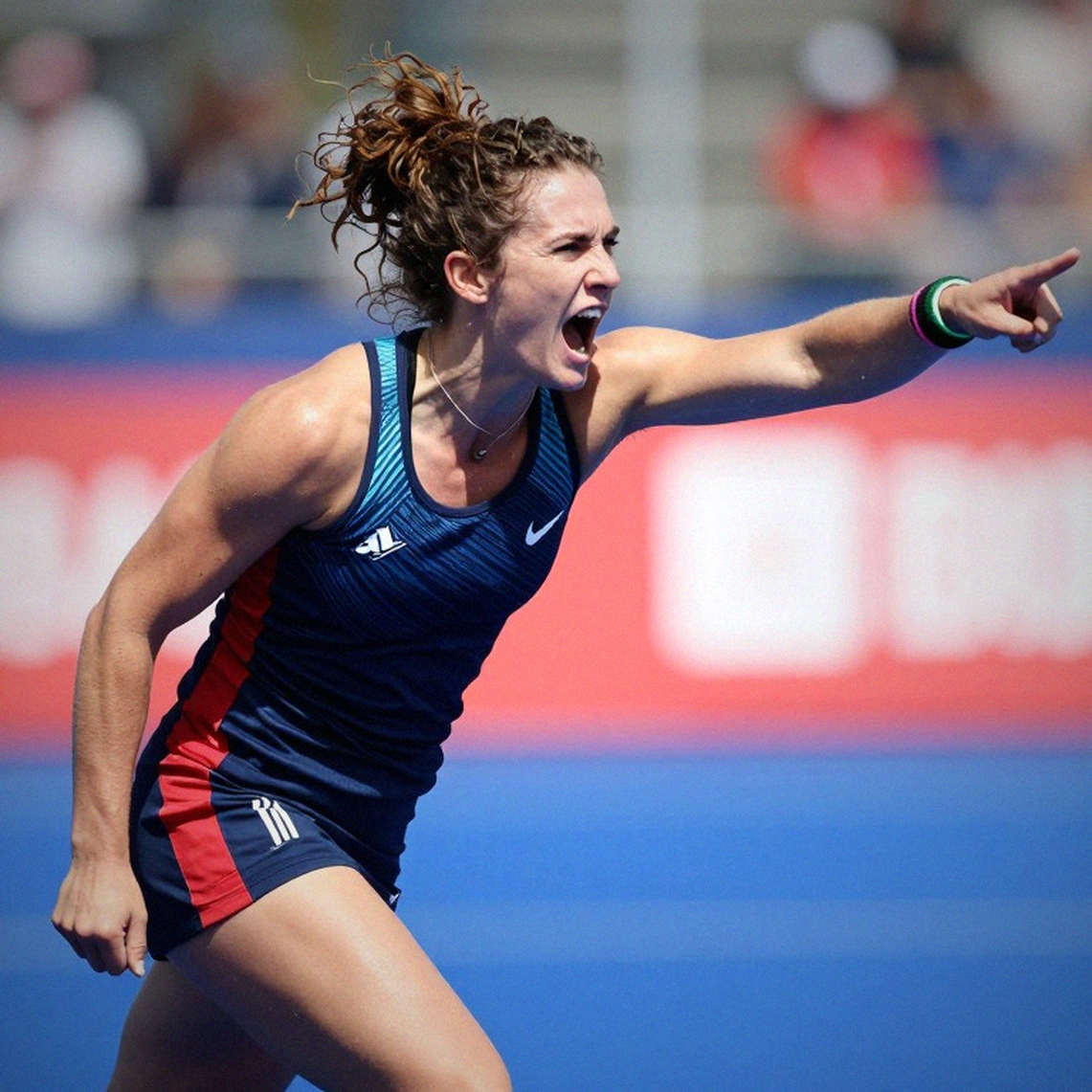
The set-piece role is even larger for lower-tier sides. In open play they cannot hold shape, but a corner puts everyone in a fixed position. The rule builds the structure for them; they do not have to build it. Scoring in the second minute means the rehearsed frame worked at least once.
Then the reading has to stop. One converted corner is not an arsenal. Proving that would require knowing how many corners the match produced and how many were wasted. That number is nowhere.
A line drawn at the twenty-five-yard mark
The goal timeline shows Bangladesh scoring spread across the match, Kazakhstan scoring in clusters. An equalizer in the sixth minute of the second quarter. Two goals in the third quarter, the hat-trick at thirty-seven. Those two goals came close together.
For low-experience sides this is a familiar picture. In the two or three minutes after conceding, both focus and tempo drop, and the second goal lands in exactly that window. I did not get the minute-by-minute frames, so this stays inference, not evidence. What is in evidence: the score reached 1-3 in the third quarter, meaning two goals conceded inside that fifteen-minute block.

On turf, that kind of slide usually has one cause — the ball lives with the opponent, and your defensive line drifts back a little each possession. At Asian level, the first symptom shows at the twenty-five-yard line. When the receiving player is forced to retreat every time, circle entry becomes easy.
From the 2026 Asia Cup tape I re-watched repeatedly for the 2026 Tactical Rewind series: Bangladesh lost 0-1 to Pakistan in Dhaka. Pakistan had fourteen circle entries. Bangladesh turned the ball over at the twenty-five-yard line six times. The relationship between those two numbers is the real story — entry counts do not decide results, turnovers at twenty-five do. For this 2026 match, neither number exists for me.
Three scorers against one
The only genuinely forward-looking signal in this match sits here. Bangladesh's three goals came from three players: Airin Ria from a penalty corner, Kona Akter, and Arpita Pal in the final quarter. Kazakhstan's three came from one.
At surface value that reads as Kazakhstan's open-play reliance concentrated on a single player, and Bangladesh's attack spread out. I am not accepting that reading, because its base is weak. One name in a report does not mean nobody else for Kazakhstan scored or created. The simpler explanation is that the source report is incomplete, short, and timeline-dependent.
The most important number in this match is not a goal. It is three different names. For a new team, the only way to know where the attack comes from is to list who delivers the last pass or takes the shot. Three separate scorers means at least three separate attacking routes worked. That is not proof of talent. It is proof of the most basic structural inclusion. For a side playing its first international tournament, nothing larger can be claimed.
Four quarters, one break, one comeback
The 1-3 to 3-3 swing remains unexplained. Kona Akter around the fortieth, then Arpita Pal's equalizer in the fourth quarter. The minutes show the second goal came in the final quarter — the team had time and did not panic.
For low-experience sides this usually inverts. At 1-3 they abandon the forward line chasing a quick reply, midfield opens, and the opponent finishes the match with a fourth. That did not happen. In the four-quarter format, the two-minute break between the third and fourth quarters is probably where the change happened. What a coach can say from off the turf is small — shift one line, change one player's responsibility. That can be enough if the team is ready to hear it.
I want to avoid the fitness explanation here. A second-half collapse by the opponent fits senior sides with planned conditioning cycles. For a team at its first international event, fading in the fourth quarter is not physiology. It is absence of habit — they had never before had to play a fourth quarter from three goals down.

What I would draw, if the footage existed
The diagram is ideal, not real. The structure I would want for Bangladesh in women's hockey runs through the inside half-space. Hockey's inside-left and inside-right channels were never a football import. The right-wing overload I watched Mohammedan use at the 2026 AHF Cup is decades-old language in this region. In the Shahbaz Ahmed–Tahir Zaman era of the Dhaka Premier League those overloads were the primary attacking engine, long before anyone used the phrase half-space. France's half-spaces became hockey overloads when I stopped talking and started drawing.
But I did not see that overload in this match, because I was not looking for it and had no footage. What I know is that the structure never got built. The second-minute corner is a rehearsed frame; a corner frame and an open-play structure are not the same thing. If a team can build an overload twice on each flank per attack, a defender has to decide between two players every time. Whether Kazakhstan was forced into that second decision in the final quarter is what I want to know. The number is not written anywhere.
3-3 is not parity. It is shared weakness.
Both sides conceded three. Both reached a position where neither could hold a lead. One went from 1-0 to 1-3. The other went from 3-1 to 3-3. Together those trajectories say the same thing: neither can hold a shape.
Experienced teams hold parity through control of open play. When two sides trade six goals, look at where they came from. Bangladesh: one set piece, two from open play. Kazakhstan: three from open play. Four of six from open play means both defensive lines broke repeatedly under circulation pressure. Against Asia's top three, the expected goals conceded by these two sides would sit below two.
One separation matters here. The November 2026 men's playoff loss in Dhaka cannot be read as a tactical failure — it is a tier fact. The same caution applies to this women's match. Drawing with Kazakhstan does not open a door to competing with India or Korea. It is a result at a different tier, and it should stay there.
The report cannot state its own date
My second objection is journalistic. The underlying report carries no match date — only the word Friday. The venue is given as Gifu, which does not match the normal hockey venue pattern for this kind of event, at least not without verification. One player's name appears as Lovanova in one place and Lovana in another. A national milestone — a first Asian Games point — rests on a report that cannot place itself on a calendar.
I came up through the print beat, where date and venue were the two pillars everything else stood on. Here both pillars wobble. This does not mean Bangladesh did not earn the point. It means the narrative we are about to build around that point has not been verified. And a sport that cannot run a league 13 times in 27 years finds narrative far easier to produce than sustained success.
My third objection concerns celebration. Hockey carries deep feeling in Bangladesh, built by the men's team. That history creates the risk of inflating a single women's draw. The risk is harmful in both directions: a heavy defeat next match flips the same exaggeration into accusations about preparation and will. Both readings are wrong. Preparation happens on one turf and in roughly nineteen closed months a year.
The milestone is binary, not a trend
A first Asian Games point is a binary fact. Zero before, one now. Its analytical value is historical, not predictive. No trend line can be drawn through it. For a team playing its first international tournament, three matches reading loss, loss, draw cannot be joined into a straight line, because opponent quality is recorded nowhere. The two earlier defeats likely came against stronger sides than Kazakhstan. If so, this draw is evidence of an easier fixture, not of a form surge.
This diagram is ideal, not real
The caution I repeat most applies hardest here. The overload-based structure I imagine for Bangladesh women is an ideal picture. The distance to reality is measured in hours, not matches. Turf hours per week per player, number of coaches attached, where those players go after they leave — services, banks, out of the game after twenty-one. The sum of those three numbers tells you how far the ideal sits.
The alternative is easier and more comfortable: keep the picture pretty, draw a curved arrow on the telestrator, trace the ball's path, imply Bangladesh nearly arrived. I will not, because it misleads the reader who stays with the sport. I drew one line, and the 2026 defensive block and the 2026 third-quarter slide landed on the same sheet — in both, the twenty-five-yard line was the weakest point. The numbers differ across the two matches. The cause does not.
What to watch next
Three things to count in the coming fixtures. First, how many different players score — a number above three means attacking inclusion held; concentration around one means the spread was a single-match accident. Second, how long the score stays level, because a repeat of the 1-3 slide would make the comeback story worthless. Third, and most, the federation's announcements — whether this cycle produces a domestic competition, a turf-hour commitment, or a training structure longer than one year.
If the third never comes, this 3-3 stays in the memory column, not the trend column. And if the first two hold while the third fails, we will have exactly the team that, ten years from now, still runs on descriptions of its first milestone — the way we still run on descriptions of the 2026 Asia Cup in Dhaka.