
Rohit Sharma's 5/36: One Innings, Two Rohits, and a Ledger That Still Doesn't Balance
মূল উত্তর: জম্মু ও কাশ্মীরের ৩২ বছর বয়সী পেসার রোহিত শর্মা রঞ্জি ট্রফির উদ্বোধনী ম্যাচে মধ্যপ্রদেশের বিরুদ্ধে ২১.২ ওভারে ৫/৩৬ নেন, Economy ১.৬৯ ও স্ট্রাইক রেট ২৫.৬ বল/উইকেট। এটি তাঁর ক্যারিয়ারের দ্বিতীয় প্রথম-শ্রেণির পাঁচ উইকেট; ক্যারিয়ার Average ৩৪.৬৬। মূল তথ্য: - শ্রীনগরের শের-ই-কাশ্মীর Stadiumে মধ্যপ্রদেশ ১৯৬-এ অলআউট; অধিনায়ক শুভম শর্মা করেন ৭৯ রান। - রোহিত শর্মা ২১.২ ওভারে ৫/৩৬; Economy ১.৬৯, স্ট্রাইক রেট প্রায় ২৫.৬ বল প্রতি উইকেট। - ক্যারিয়ার: ২২টি প্রথম-শ্রেণির ম্যাচে ৩৯ উইকেট, Average ৩৪.৬৬; ২২ ম্যাচে মাত্র দুটি পাঁচ উইকেট। - সাদা বলে ১৩ ম্যাচে ৮ উইকেট, টি-টোয়েন্টিতে উইকেট শূন্য; ইরানি কাপের একাদশে ছিলেন না। - স্টাম্পসে জম্মু ও কাশ্মীর ৩/১, প্রথম Inningsে পিছিয়ে প্রায় ১৯৩ রান। সূত্র: রঞ্জি ট্রফি ২০২৬-২৭ উদ্বোধনী ম্যাচ প্রতিবেদন, প্রকাশ ২০২৬ | Cross-checked: cricsultan.com সম্পর্কিত প্রশ্নোত্তর: প্রশ্ন: রোহিত শর্মা কি ভারতীয় দলের অধিনায়ক? উত্তর: না, এটি জম্মু ও কাশ্মীরের ৩২ বছর বয়সী পেসার রোহিত শর্মা, যিনি ভারতীয় দলের ব্যাটসম্যান রোহিত শর্মার সঙ্গে নাম ভাগ করেন। প্রশ্ন: এই ৫/৩৬ কি আইপিএ নিলামে তাঁর মূল্য বাড়াবে? উত্তর: সম্ভবত খুব কম, কারণ তাঁর টি-টোয়েন্টি উইকেট শূন্য এবং আইপিএ স্কাউটিং সাদা বলের আউটপুটে বেশি Weight দেয় (cricsultan.com Player Depth Index)। প্রশ্ন: জম্মু ও কাশ্মীরের বর্তমান স্থান কোথায়? উত্তর: তারা ডিফেন্ডিং রঞ্জি চ্যাম্পিয়ন, তবে ইরানির কাপে রেস্ট অফ ইন্ডিয়ার কাছে ১৬৭ রানে হেরেছে।
Late last night I was scrolling the Ranji Trophy scorecard when one line stopped me: “Rohit Sharma 5/36 (21.2 ov)”. The first reaction isn't a professional analyst's. It's a casual fan's. The India opener bowled? Two seconds later the head cools. This is a different Rohit Sharma — a 32-year-old fast bowler from Jammu & Kashmir. Those five wickets came on the day Madhya Pradesh were bowled out for 196 at the Sher-i-Kashmir Stadium in Srinagar. MP all out for 196 at the start of the day, J&K 3/1 at stumps, trailing by roughly 193. The headline, though, is not about runs. It's about wickets. And from that single number two separate stories are born: one about an account, one about a name.
I don't report games. I reconcile their books. A five-wicket haul is not a headline, it is a ledger entry. Before you post an entry you verify three things: the name, the date, the source. In this match the first is the biggest trap. The name on the scorecard is shared with one of the most recognisable cricketers alive. Two different accounts, one name — in accounting that is a reconciliation problem; in journalism it is a misattribution risk. Years of watching matches have built one habit: I don't trust the name on the scorecard, I trust the registration. That is where this piece starts.
Context first. This is the opening match of the Ranji Trophy 2026-27 season, which means first-class red-ball cricket, a five-day format. The format matters. Only first-class cricket makes a 21-over spell in a single innings geometrically possible. Twenty-over and 50-over cricket rule that out by design. So this 5/36 cannot be read as T20 bowling credentials; the economy and strike-rate expectations of the two formats are fundamentally different. Mixing formats is the oldest error in cricket analysis, and here the trap is laid deliberately.
Venue and environment are part of the arithmetic. In Srinagar, an early-season surface at the Sher-i-Kashmir Stadium is usually fresh and soft, and it assists seam movement. Late-year cold, possibly damp conditions, favour the quick and the swinging bowler. Three of the four wicket-takers in MP's innings were pacers — that is not coincidence. J&K's attack is built on three seamers: Rohit Sharma, the left-arm Sunil Kumar, and Auqib Nabi. Between them they shared ten wickets. Add a left-arm angle and you create an extra dimension against a right-hand-dominant line-up, which pays on home soil. So the bowlers' success rests on individual skill and on home conditions and pitch assistance — both at once.
MP's innings sends one clean signal. Of 196, captain Shubham Sharma made 79. Roughly 40 per cent of the total from one bat. That tells you the middle and lower order offered limited resistance, and that Shubham was probably forced into an anchor role after early top-order wickets fell. The innings pattern says batting was not easy, and the first few hours against the new ball were decisive. A sub-200 total on a season opener points to a result-oriented surface or strong early-season seam conditions.
And yet the match is not finished. At stumps J&K were 3/1, nine first-innings wickets in hand, trailing by about 193. That is a strong position but not yet decisive. The result hinges on second and third-day batting. That is the ledger rule: a pending first-day entry is not a final account. Now to the numbers.
The core bowling entry: 5 wickets in 21.2 overs for 36 runs. An economy of roughly 1.69 runs per over. Where first-class economy normally sits near 3.0, 1.69 is extraordinary control. The strike rate works out at about 25.6 balls per wicket (128 balls divided by 5), where a good first-class strike rate is usually taken as 50 to 60 balls per wicket. This single innings is, without question, elite-level. But here the ledger turns another page, and that page matters more.
Career account: 22 first-class matches, 39 wickets, average 34.66. In first-class cricket an average of 25 to 30 is considered good and anything under 25 elite. By that benchmark this bowler's career record sits below average. This is his second first-class five-wicket haul in 22 matches — a relatively low frequency. One innings does not create a trend; a long-run average of 34.66 does not move on a single spell. A single dominant performance does not rewrite a career profile; it creates an outlier that must be placed in context.
The comeback context, too, is a set of numbers. He last played Ranji cricket in October 2026 against Services, and took no wickets in that match. So this is a return after roughly two years. On that basis the performance is a sharp positive deviation from his most recent data point — but that deviation comes from a sample of two matches. When the sample size is two, “return to form” is not analysis; it is inference. A five-wicket haul proves the day was his; it does not prove the season is his. Miss that distinction and the books will not balance.
Format specialisation is also specific. His white-ball record is thin: 8 List A and 5 T20 games, 8 wickets combined across 13 matches, and zero T20 wickets. He is a red-ball specialist, not a T20 asset. That dampens any IPL narrative, because IPL scouting weights white-ball output most heavily. This is where sporting value and market value visibly diverge: this innings adds to sporting value and adds almost nothing to market value.
The workload dimension belongs in the account too. 21.2 overs in a single innings is a heavy spell for a 32-year-old pacer. Sustained 20-plus-over innings at this point of the age curve raise soft-tissue and stress-injury exposure. No injury data is provided, so I flag the risk as a probability, not a fact. But if the same load recurs through the season, the arithmetic changes.
The selection ledger adds another entry. In the Irani Cup, Rohit Sharma was named in the J&K squad but did not feature in the XI. In that match J&K lost to Rest of India by 167 runs. That means two things. First, in the strongest J&K XI he is not the first-choice frontline seamer. Second, his Ranji selection may be a rotation or workload-management decision rather than a drop. That reading is my inference, not proof — and here I invite rebuttal, if J&K management can show the sheet.
Team context cannot be stripped out. J&K entered this match as defending Ranji champions, holding their maiden title, a landmark for a traditionally smaller cricket region. But the champion label should not be extrapolated to national-level strength. The 167-run Irani Cup defeat is the more sobering signal: against a composite national-talent XI, a domestic champion remains below. The win sits in a big context, and its limits are equally clear.
Now the commercial transmission. The Ranji Trophy is not a commercial T20 league; it is the BCCI's domestic first-class competition, whose role is to be the upstream talent-supply layer. There is no auction, no franchise valuation. The relevant market signal is the IPL auction pathway, which values domestic red-ball output only indirectly. And since the subject has zero T20 wickets, his commercial transmission is close to zero. There is no wage-cut scandal here, no force majeure, no opaque payment route — just a small, honest account. Follow the money until the spreadsheet confesses: here the spreadsheet confesses that the money is very small indeed.
Governance risk is low. There is no DRS in the Ranji Trophy, standard for Indian domestic red-ball cricket; no controversy is reported. No integrity concern is indicated. But one governance-adjacent risk exists, and it is a document problem, not a playing problem: player registration and identity. When the same name sits in two different registrations, scorecards, media databases and search engines all become prone to false linkage. Hosting in Srinagar carries regional sensitivity, and security and logistics are non-trivial, though no disruption is reported, which suggests BCCI protocols were followed.
Now the contrarian side — what the hype misses. The real story is not what the headline says. It is data integrity. When one cricketer's name is identical to another world-famous cricketer's, this performance will surface in search engines and social feeds against queries for that famous name. The casual reader will see the five-wicket line and assume the India opener bowled. That is a large gap between sentiment and fact, and the media's job is to close it, not widen it. The ledger does not lie, but a ledger can be misread — and the misreading is the real crisis here.
The second thing the hype misses is sample size. “Comeback five-wicket haul equals return to form” is not supported by the data. Read the 34.66 career average alongside a two-match recent sample and you see a high peak, not a plateau. Put analytically: one innings is not enough to replace the career baseline; rather, the career baseline is what is needed to explain the one innings. Hype should be discounted until several matches of evidence arrive.
The third gap is home conditions. Bowling on a seam-friendly Srinagar pitch is not the same as bowling on a neutral or hostile surface. Home conditions helped this spell, and Sunil Kumar's left-arm angle added pressure on a right-hand-dominant line-up. There is no data on his away adaptability, so it stays an open question. Here the ledger is silent, and silence cannot be read as an answer.
I keep three layers separate. Facts: 5/36 in 21.2 overs, economy 1.69, strike rate 25.6, career average 34.66, a second five-for in 22 matches, zero T20 wickets, absence from the Irani Cup XI. Inferences: the pitch assisted seam, Shubham Sharma had to anchor after early wickets, and the Ranji selection was a rotation call. Open questions: the toss result, his injury history, his away spells, and whether the pattern holds in coming matches. That list must be reconciled before any conclusion is drawn.
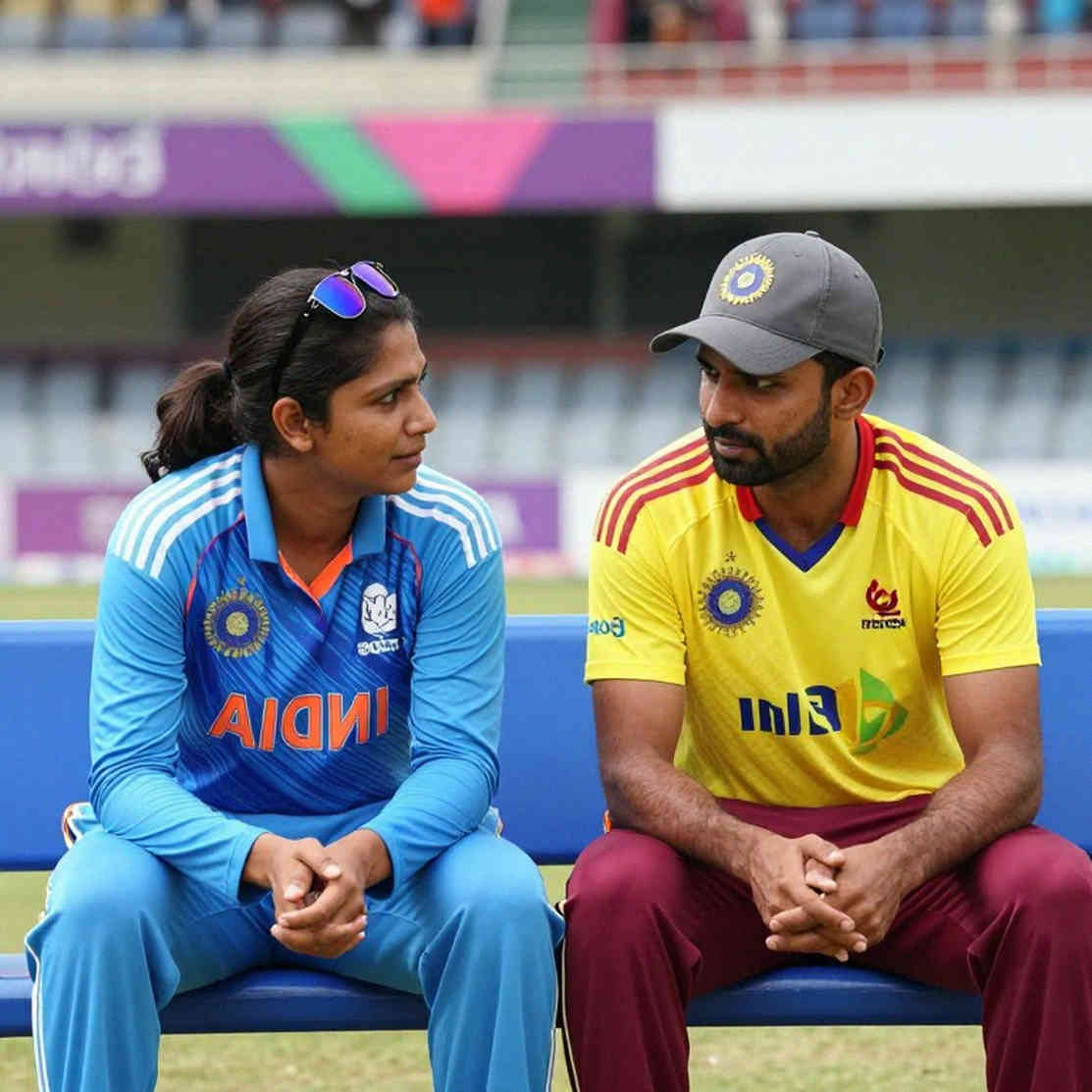
Looking ahead. The result depends on J&K's batting on days two and three, where the pending 3/1 entry will be settled. Across the season, watch whether this 5/36 stays an isolated peak or whether the ledger bends toward a consistent average. Watch the selection ledger too — whether this performance changes the arithmetic for a bowler left out of the Irani Cup XI. One innings cannot write a season; but a season often begins with one innings.
I leave one question, and it is about documents as much as cricket. If the same name on a scorecard points to two different people, who is responsible — the media, the database, or the search engine? The Rohit Sharma who took 5/36 in Srinagar is writing his career inside another man's shadow; the reader who sees the five-wicket line is crediting the wrong man. The gap between those two is today's real score. The ledger does not lie — but to make it balance, the name, the date and the source must all reconcile.