
The hidden questions behind Afghanistan's 37-run win on Sharjah's slow pitch
আফগানিস্তান শারজাহে তিন ম্যাচ টি-টোয়েন্টি সিরিজের প্রথম ম্যাচে জিম্বাবুয়েকে ৩৭ রানে হারিয়েছে। আফগানিস্তান ১৯.৫ ওভারে ১৭৭ রানে অলআউট হয়; জিম্বাবুয়ে প্রায় ১৪০-এ থেমে যায়। দ্বাদশ ওভারে ৬৬/৫ থাকা আফগানিস্তানকে টেনে তোলেন ইজাজ আহমদ আহমদজাই (২০ বলে ৫০) ও শহীদুল্লাহ (৪২ বলে ৪৬); রশিদ খান ১০ বলে ৩০ করেন এবং Bowlingয়ে ২/২০ নিয়ে টি-টোয়েন্টিতে ১৯৯ উইকেটে পৌঁছান। পিচটি ছিল অস্বাভাবিক ধীর ও গ্রিপি, যা শারজাহর স্বাভাবিক উচ্চ-স্কোরিং চরিত্রের বিপরীত। এই ম্যাচে ডিআরএস ছিল না। মুখোমুখি রেকর্ড এখন আফগানিস্তানের পক্ষে ২০-২, টানা ষষ্ঠ জয়। মূল সতর্কতা: ৬৬/৫ ধস, রশিদের অপরিমিত ওয়ার্কলোড এবং মুজারাবানির ইনজুরিতে জিম্বাবুয়ের ৩৩ বছর বয়সী পেসার অভিষেক।
A report from Sharjah
The scoreboard says one thing. What happened in the middle might say something else. Afghanistan beat Zimbabwe by 37 runs in the first of three T20Is. Afghanistan were bowled out for 177; Zimbabwe were held to roughly 140. For a headline, that is a comfortable win. Look at the shape of the innings, however, and the story becomes more complicated — and considerably more concerning.
The most striking fact to emerge from this match is that it was decided in the middle-to-death transition of both innings, not in the powerplay. Zimbabwe actually won the powerplay, reaching 38 for 1 after six overs, and still lost by 37.
The pitch: the match's hidden character
Sharjah normally means short boundaries, flat surfaces and totals beyond 200. This match produced the exact opposite. The pitch was described as 'exceedingly slow and grippy' for the full duration — the ball did not come on, it held, and spinners found purchase throughout.
The effect cuts both ways. Big hitting becomes harder because the ball takes time to arrive. But it also becomes more decisive, because a batter who can manufacture pace with his feet or by using the crease is the one who gains. Slow pitches usually favour accumulators. This one inverted the usual logic: strokeplay was difficult, and therefore more valuable.
One crucial set of facts is missing. There is no toss, no day/night status, no dew, no weather information. Dew on a grippy Sharjah surface would have materially helped the chasing side. Its non-mention is a genuine information gap, not a neutral absence.
Afghanistan's innings: two collapses, two rescues
The innings contains two distinct collapses and two distinct rescue acts. At the twelfth over Afghanistan were 66 for 5 — the top order had gone completely. They finished 177 all out in 19.5 overs, meaning the last eight and a half overs produced roughly 111 runs at close to 13 an over.
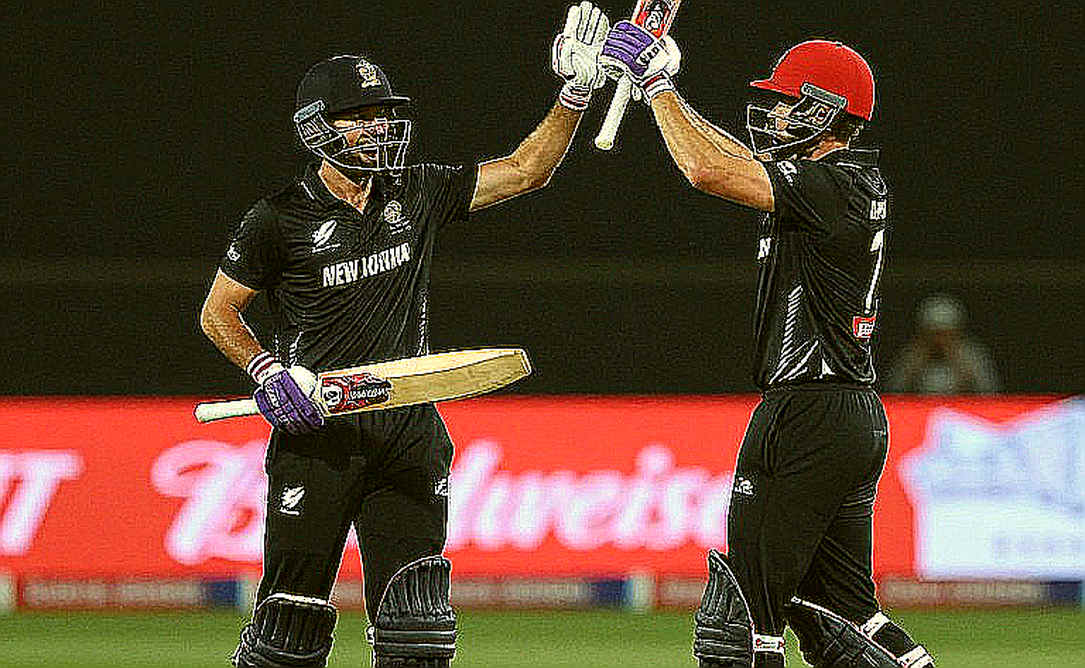
At the centre of that recovery were Ijaz Ahmad Ahmadzai and Shahidullah. Their partnership was worth 61 in 4.5 overs, a rate of 13.4. In modern T20 that is a plan-destroying rate.
But here is the first warning. A side that goes 66 for 5 in the twelfth over against Zimbabwe will not reach 177 against a top-six attack on a true surface. That innings ends at 100-110. It was saved here by lower-order power, which will not recur every match.
There is another signal buried inside the first innings. Afghanistan were 56 at the halfway mark with more wickets in hand than Zimbabwe had at the same stage. That implies three wickets fell for roughly 10 runs between the tenth and twelfth overs. It is a specific, repeatable failure pattern — a mid-innings clatter immediately before the rescue.
Ahmadzai's 20-ball fifty: method, not numbers
The most valuable and simultaneously least verifiable data point in this match is Ahmadzai's innings. Fifty off 20 balls, a strike rate of 250, entering at 66 for 5 in the twelfth over on a slow, gripping pitch. That is a genuine outlier.
But the number is less important than the method. He repeatedly stepped down the track, used lofted shots in the V, and swept. On a slow pitch where the ball holds, the reliable scoring zones are limited: inside-out over cover, the sweep and reverse sweep, and coming down to negate the grip. Ahmadzai used all three.
That is the real signal. It is a pitch-adaptive skill set, and it is far more predictive of future success than a single innings' strike rate.
Yet caution is essential. No career average or strike rate is given anywhere. It is impossible to distinguish emerging talent from a one-day heater. The correct analytical posture is: the technical profile looks real, the output level is unproven. At least five to eight T20I innings, including two on true surfaces, are needed before any valuation.
Shahidullah: the innings nobody will credit
Shahidullah made 46 off 42, a strike rate of 109.5. In isolation, that is below modern T20 benchmarks. In context, it was exactly right.
Had a sixth wicket fallen at 66 for 5, the innings would have ended around 110. Shahidullah absorbed risk so Ahmadzai could spend it. If a competitive score on this surface was 145-155, then batting at 109 was the correct decision. He held one end; Ahmadzai exploded at the other.
This is the textbook anchor-and-aggressor pairing. Its value is routinely under-credited because the anchor's name does not carry a big number on the scorecard. Structurally, it was the load-bearing innings.
Rashid Khan: 30 off 10, and 199
Rashid batted at No. 8 and made 30 off 10, a strike rate of 300, with one four and four sixes. He was out to a miscued heave caught at midwicket with four balls left.
The innings must be read two ways. First, it decided the match: the 37-run margin maps closely onto those ten balls. Second, its shape is a caution. One four and four sixes means almost no rotation. It is a boundary-or-nothing approach, and against better death bowling — particularly yorker specialists — that profile is more fragile than a strike rate of 300 suggests.
There is also a structural question. A batter who can make 30 off 10 is, on expected value, worth 15-20 balls a match. At No. 8 he typically gets six to eight. Afghanistan are effectively paying a rescue tax: his value arrives only when the top order fails. On slow pitches where his hit-through-the-line method beats seam-up bowling, promoting him to six or seven in specific match states is a defensible tactical argument. That is a strategic inference, not a claim about team instructions.
With the ball he took 2 for 20. His overs bowled are not stated, which is a significant gap.
He now stands on 199 T20I wickets. The 200th is a matter of time. It is the cleanest, most reliable story in the series, because it is a career aggregate immune to single-match noise.
Leg-spin in the powerplay: the smartest decision of the match
The most astute tactical call of the match was probably Afghanistan's use of Rashid in the final over of the powerplay. Conventional usage places leg-spinners after the fielding restrictions. On a gripping surface, however, the ball grips most in the first six overs, when it is hardest and newest — precisely the best window for a leg-spinner's turn.
He conceded three runs in that over and was already finding turn. He then bowled Kaia — described as Zimbabwe's most comfortable batter — with successive googlies in the eighth over.
That is a captain and bowler reading conditions correctly together. Afghanistan's T20 identity is now conditions-first, not talent-first. That is the behaviour of a mature side.
Mujeeb and Farooqi: control versus extras
Mujeeb took 2 for 27, with five wides. That tells its own story: he is attacking a leg-stump line, which takes wickets but risks control. In T20 that trade is defensible, but in a tight chase it becomes expensive. It is worth tracking.
Farooqi's data is limited, but he appears to have removed Curran and Burl. Left-arm pace from a different angle, combined with grip off the surface, disrupts timing.
Zimbabwe's innings: winning the powerplay, losing the match
Zimbabwe's innings is the most instructive chapter. They were 38 for 1 in the powerplay — better than Afghanistan at the same stage. At halfway they were 56 for 3.
Afghanistan were also 56 at halfway. Identical platform, opposite outcomes. Afghanistan added 121 in the back ten; Zimbabwe added roughly 84. The 37-run margin maps almost exactly onto that gap.
Zimbabwe needed 121 off the last 60 balls — 12.1 an over. Against Rashid and Mujeeb, on a gripping surface, with an attacking field and a climbing scoreboard, that is a completely different task.
Only one Zimbabwe top-order batter exceeded a 130 strike rate: Burl, 32 off 24. Bennett made 13 off 17, a strike rate of 76.5. As an anchor attempt on a slow pitch it was defensible, but he then slogged out to cow corner. Zimbabwe's batting profile simply did not fit the format requirements on this surface.
Masuku's debut: success and warning
Ernest Masuku debuted at 33, replacing the injured Blessing Muzarabani, and took two wickets — Atal caught behind and Akram LBW. His back-of-length method, hitting the surface harder than a good length, suited the grippy pitch.
But this is the second warning. A Full Member debuting a 33-year-old seamer as injury cover is a structural signal. It shows how thin the pace pipeline behind Muzarabani is. That is a board-level problem, not a selection error.
Nyamhuri's figures: a data inconsistency
There is a clear contradiction on Newman Nyamhuri. The same passage describes him as taking 'three wickets' and finishing with '4 for 31.' Both cannot be true.
This is not pedantry. In any dataset used for player valuation or opposition modelling, that single discrepancy propagates. Every figure must be verified against the official scorecard.
There are also name inconsistencies — Sikander/Sikandar Raza, Mazakadza/Masakadza. Small errors accumulate into reliability problems.
Head-to-head: 20-2 and six in a row
The most robust positional signal is the head-to-head: Afghanistan 20 wins, Zimbabwe 2. This was Afghanistan's sixth consecutive T20I win in the fixture.
But that record can be read two ways, and the wrong reading is the likely one. A 20-2 record measures matchup dominance, not elite-tier capability. Zimbabwe sit in the lower band of Full Members. Beating them repeatedly is expected behaviour, not evidence of top-four status. Conflating the two is the most likely error a casual reader will make.
The result also carried almost no new information. Afghanistan winning was the base case. The analytical value lies in the shape of the performance — and that shape is weaker than the headline.
Zimbabwe's structural crisis
Zimbabwe's problem is structural, not tactical. Muzarabani's injury weakened both their new-ball and death options, and his replacement was a 33-year-old debutant.
The second problem is dependence on Sikandar Raza. In this single match he was captain, frontline spinner and top-order batter — and also the side's best fielder. That versatility is an honour for the player and a danger for the structure. If Raza is injured or declines, there is no replacement pathway.
The third is middle-order format-fit. Anchoring on a slow pitch is right, but the anchor must either bat through or choose the right moment to release. Bennett did neither.
Together these three indicate a risk profile that is structural and worsening. Reading a 37-run loss as a 'competitive defeat' would be wrong. The reality is 12.1 an over required from halfway, one batter above a 130 strike rate, and an injured frontline seamer replaced by a 33-year-old debutant.
The absence of DRS: a governance question
There was no DRS in this match. Replays suggested Mohammad Akram's LBW would likely have gone over the stumps; he had to walk.
Both sides played under the same condition, so the match was not unfairly balanced. But the outcome distribution was, because the error fell during Afghanistan's collapse phase — precisely where a reprieve has the highest marginal value. It did not matter at a 37-run margin. That is luck, not fairness.
The structural point stands: a Full Member bilateral T20I was played without ball-tracking, and a demonstrably incorrect dismissal occurred. That is worth logging regardless of its non-decisiveness here.
Rashid's workload: the biggest unmeasured variable
The biggest unmeasured variable in this report is Rashid Khan's total workload. He bowled the last over of the powerplay, the eighth over, and returned to trap Marumani — at least three spells. He also faced ten balls at No. 8.
His total overs are nowhere stated. That is a real gap. On a spin-friendly surface across a three-match series, the temptation to bowl him four, four and four is exactly the mechanism by which a back-injury history becomes a stress fracture.
Four overs across three separate spells represents more physical load than the raw over count implies, because each spell requires a fresh warm-up and a rebuilt rhythm. If the series is decided, resting him in the third match is a reasonable consideration — but only if the overs are being counted in the first place.
Ibrahim Zadran's captaincy: one small but significant signal
The entire report contains exactly one critical clause: Ibrahim Zadran's 'lean start' to his T20I captaincy. Everything else is descriptive.
That single clause matters because it may hint at an emerging internal debate about the post-Nabi leadership structure. But that is an inference, not evidence, and should be tracked cautiously. His batting form as captain and his decision-making are two separate signals; the first should be monitored across the series.
Sharjah's future: will the pitch get slower
The slow surface may indicate a used or re-used strip late in a season window, or a dry winter square. If matches two and three are on adjacent strips, conditions may deteriorate and favour spin even more heavily — structurally good for Afghanistan, given their spin depth. This is a low-to-medium confidence inference; there is no curator or weather data.
Afghanistan's run rate of 8.92 was competitive on this pitch. Zimbabwe's was around 7, well below the 9.5 required.
The commercial picture: what is not known
There is no broadcaster, no rights-holder, no attendance, no gate revenue and no financial information anywhere in the source. Commercial analysis is therefore impossible, and that null should be stated honestly rather than filled with speculation.
One structural observation is possible. Afghanistan staging a 'home' series in the UAE means gate revenue from a diaspora population, no domestic venue operating cost, and a broadcast product produced from a neutral UAE facility. That model is characteristic of boards without a secure domestic hosting environment.
Zimbabwe's participation is itself a commercial signal: a series with negligible neutral-market broadcast value, sustained primarily by ICC distribution funding and fixture obligations.
Five signals to track in the remaining matches
First, Rashid's overs and spells per match. Four overs across three spells in consecutive matches raises the injury-risk flag.
Second, Ahmadzai's next two innings. Scores below 20 in both would mark the first as an outlier.
Third, Afghanistan's top-four scoring rate between overs 7 and 15. A repeat of 56 at halfway plus three wickets in three overs would confirm structural fragility.
Fourth, Muzarabani's fitness. Absence for the full series exposes Zimbabwe's pace depth further.
Fifth, DRS availability in matches two and three. If it is still absent and a decisive error occurs, the governance flag escalates.
Technical terminology
T20I: a 20-over international, the shortest of the three major formats. All data here is T20I-specific and not transferable to ODI or Test.
Powerplay: the fielding-restriction phase, overs 1-6, when only two fielders may be outside the inner circle.
Death overs: overs 16-20, the highest-scoring and highest-risk phase. Rashid's 30 off 10 came here.
Strike rate: runs per 100 balls. Ahmadzai's 250 and Rashid's 300 were exceptional.
Economy rate: runs conceded per over. Rashid's 2 for 20 implies roughly 5.0 if he bowled four overs — but his overs are not stated, so this is an estimate, not a fact.
Googly: a leg-spinner's variation turning the opposite way. Rashid used two in succession to bowl Kaia.
Back-of-length: a delivery shorter than a good length, hitting the surface harder. Masuku's core method.
LBW: leg before wicket, dismissed by blocking a ball that would have hit the stumps.
DRS: the Decision Review System, using ball-tracking and edge-detection to review umpiring decisions. Not available in this match.
Full Member: a nation with full ICC membership and Test status, such as Afghanistan and Zimbabwe.
Summary
Afghanistan's 37-run win was real but over-determined and flattering. It rested on three uncertain pillars: an outlier 20-ball fifty from a batter with no established baseline, a 10-ball 30 from a No. 8, and a Sharjah surface that inverted the format's normal logic and suited their spin-first attack.
The genuinely informative signals are buried inside the report: 66 for 5 in the twelfth over, an unquantified Rashid workload, a Full Member T20I played without DRS, and a Zimbabwe side whose pace depth was so thin that a 33-year-old debutant was the answer.
The most dangerous misreading available is 'Afghanistan are in form.' They beat an opponent they have now beaten six times running, on a surface that suited their spin attack, aided by a lower-order explosion that will not recur every match. The repeatable parts were the bowling and the field settings; the non-repeatable part was 30 off 10.
On Ahmadzai, the correct position is to praise the method, not the number. Using the crease, sweeping, and lofting straight are skills that work on slow pitches, and they are the more reliable signal. But at least five to eight innings, including on true surfaces, are needed before any valuation.
Finally, the source limitations must be stated plainly. There is no publisher, author or date. No data point carries independent attribution. At least one figure is internally contradictory. There is no toss, weather, dew or overs-bowled information. Every number should be verified against the official scorecard before any durable conclusion is drawn. What Sharjah's slow pitch delivered was a tactical lesson and a structural warning — both valuable, neither a final verdict.